The Whining Stranger
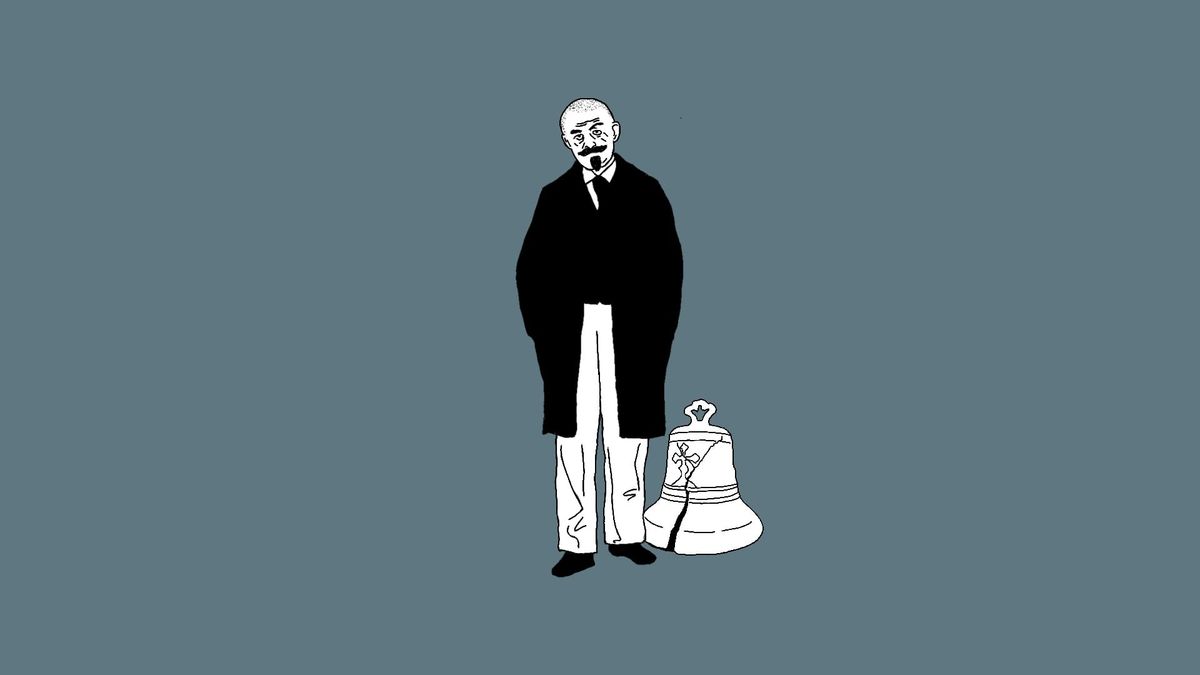
The old world is dead. The new world is nowhere in sight. In this interregnum a great variety of aesthetic problems appear. The Whining Stranger is an ongoing series that examines these problems through the lens of 19th Century French novelist Joris-Karl Huysmans.
It takes a special breed of malcontent to live at a time known as the Beautiful Era and regard it as “the age of universal imbecility,” and Huysmans was just such a creature.
He was born on a street named for Suger, the great cathedral builder. His father, the last of a long line of Dutch painters, died when he was very young. His mother remarried, in his estimation, far too fast. As a child he was miserable at school and miserable at home.
He served—if you can call it that—in the French Army during the Franco-Prussian War of 1870, but saw no action, spending the whole war malingering in field hospitals and sneaking out with his friend to look at old churches.
Like any self-respecting French novelist, he was a dedicated, prolific patron of brothels and a hysterical misogynist.
Winning early notoriety as a polemical, shit-stirring art critic, he was among the first champions of the Impressionists, and his judgments in that regard exerted a powerful influence on their canonization.
He was easily upset by loud noises and ungraceful architecture, a condition which turned inward in the form of vicious, lifelong stomach problems, then turned outward again as a lifelong fixation on the bilious, purulent, and scatological. He wrote a much-derided prose poem in which, in the words of his biographer, he “had striven to differentiate the diverse odours of feminine arm-pits.” He had a brief, unsatisfying bi phase.
He professed, and subsequently condemned, every major literary movement of his day. He was vigorously self-centered and his novels invariably autobiographical. He was gratingly conservative and irredeemably contrarian. He hated bourgeois and proletarian with equal intensity.
Living and working in the era that prompted Nietzsche to proclaim the death of God, Huysmans spent his whole life in search of the supernatural. Something, anything, “anywhere out of this world” that so offended his sensibilities. His search ended at the foot of the cross. He retreated to a cloister and died in agony a pious man.
In the motives of his world-contempt, in his aesthetic and spiritual struggles, in his countless wrong turns and myriad self-inflicted wounds, he has much to teach us.
Entries in this series are indexed below.
Part I: The Scent of Blood & Roses